Do you experience pain or discomfort in the shoulder?
Is the pain aggravated when you lift your arm or reach for something? You could be suffering from a very treatable condition known as impingement syndrome-here is how Chiropractic can help you!

WHAT IS IMPINGEMENT SYNDROME?
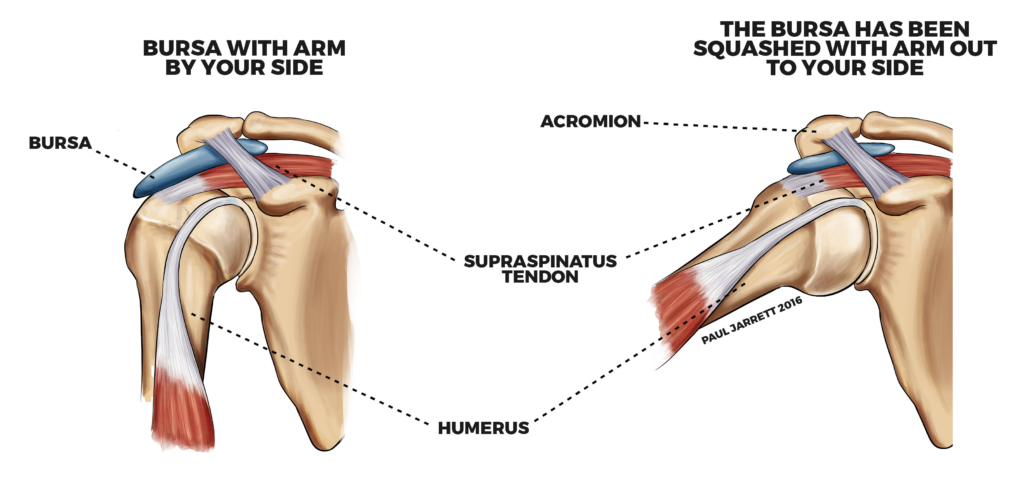
Impingement syndrome of the shoulder is a very common cause of shoulder pain. It is friction or a pinching of the muscle tendons (or bursa) as they pass through the sub-acromial space (the space between the head of the humerus and the acromion of the scapula). Pain is typically exacerbated by arm movements such as lifting or reaching and especially overhead activities. It is typically a repetitive overuse injury often brought on by sports involving these actions such as swimming, tennis, golf, gym, etc but may be brought on by actions as innocuous as painting or sanding.
HOW DOES IMPINGEMENT SYNDROME HAPPEN?
It is typically due to a slight narrowing or compromising of the sub-acromial space due to :
•An inflammation of the tendons passing through the space-typically the supraspinatus and biceps tendons and the sub-acromial bursa, typically from overuse.
•An elevated humeral head (the ball of the ball and socket joint) in the glenoid cavity (the socket in the shoulder joint) due to over-developed shoulder elevator muscles( deltoids etc).
•Weak humeral head depressors causing an upward hiking of the humeral head in the glenoid cavity on arm elevation.
•Dysfunction in ANY of the surrounding joints which influence the shoulder biomechanics. The shoulder joint proper (gleno-humeral joint) is a shallow ball and socket joint with multiple other joints contributing to it’s normal biomechanics. These include the sterno-clavicular, acromio-clavicular, scapulo-thoracic, cervical spine and thoracic spine joints. Many muscles of the shoulder such as the levator scapulae, trapezius, and the rhomboid muscles attach directly into the spine. Logically any spinal dysfunction will thus directly influence these muscles and thus affect the shoulder biomechanics as well. The entire nerve supply to the shoulder also originates in the cervical spine (C3 to C6 primarily).
•In more serious scenarios, abnormally lengthened bones around the joint( acromion) or bony spur formation into the space may indicate surgical intervention.

HOW DO YOU TREAT IMPINGEMENT SYNDROME?
Thankfully Chiropractic adresses dysfunction in all of the abovementioned joints and muscles influencing the shoulder! Your Chiropractor will go about examining the joints for a normal range of motion. They will then perform a series of muscle flexibility/strength tests to isolate muscle imbalances which may be causing the problem (this very commonly includes weaker humeral head depressors due to excessive elevation/lifting actions, causing the humeral head to hike upwards causing impingement).
•Muscle spasm and muscle trigger points are released via soft tissue therapy, massage and myofascial trigger point therapy.
•Any joint dysfunction will be treated with specific mobilization/manipulation to restore normal movement patterns to the respective joints.
•Stretches are given to achieve normal joint capsule/muscle flexibility.
•Specific muscle strengthening exercises are prescribed to correct any imbalances and normalize the shoulder movement patterns (scapular rhythm).
•Habit patterns and incorrect techniques are replaced with correct form to avoid future relapse of the injury.

CHIROPRACTIC DOES NOT JUST TREAT THE PAINFUL POINT!
By addressing all the joints and muscles involved, Chiropractic offers a holistic, sustainable solution to impingement syndrome of the shoulder.
Please note that impingement syndrome is BEST TREATED EARLIER RATHER THAN LATER -before the formation of scar tissue, adhesions, calcific deposits etc.

SO SHOULDER UP AND GET YOUR PROBLEM SEEN TO! Written by Dr Etienne Greyling.